Wednesday, March 13, 2013


A Review: A Prince Among Stones by Rupert Loewenstein


by


Review by R.E. Prindle


Loewenstein, Prince Rupert: A Prince Among Stones: That Business With The Rolling Stones And Other Adventures, 2013, Bloomsbury


Some will rob you with a six gun,


Others use a fountain pen.


-Pretty Boy Floyd, The Outlaw

Now comes the very welcome autobiography of the Rolling Stones eminence gris, financial expert, Rupert Loewenstein, a moments surcease from the excesses of Spanish Tony Sanchez, Marianne Faithfull and Keith. A respite from biographers Christopher Anderson, Philip Norman, A.E. Hotchner and the other sexually obsessed writers. A pause in the hothouse atmosphere of Mick’s groovy sexual liaisons, temporary and otherwise. Rupert keeps his dick in his pants.

When in 1968 the Stones realized that the inexperience of their youthful years was cracking down to destroy their dreams, their hopes had been concealed and buried in truckloads of contracts and documents they couldn’t read and would never understand. Enter Rupert the investment banker from The Square Mile, well mannered and ‘with it’ in ways Rockers could ever understand much less emulate. But Mick tried.


Happy Mick Jagger


Entangled by the youthful inexperience of their first manager seconded by his partner Eric Easton and outright robbed by fountain pen wielding Allen B. Klein, Mick Jagger turned to Rupert Loewenstein as a thirsting man in the Sahara desert. As despised rock and rollers Jagger was turned down by the lawyers and accountants he pleaded with to salvage the Stones situation.


Christopher Gibbs, friend of Bob Fraser, approached Rupert as an old Etonian and asked his help. Rupert considered and accepted.


After reading internet reviews of Rupert’s book the general consensus seems to be a general rejection. The fact that Rupert took the first sixty pages to explain his origins and give some background offended the majority of reviewers who expected him to begin with glowing accounts of Mick and Keith. As Rupert’s technique was to place himself in his environment, so markedly different from the rest of us, most reviewers interpreted his method as mere name dropping.

I enjoyed the pages and thought Rupert’s technique quite skillful. As his explication narrowed down to his first encounter with Mick as he stepped over his prone drugged out form at a party I became aware of who Rupert was and how he arrived at the crossroads of his life.

At that point he was an owner of the small merchant banking firm of Leopold Joseph & Sons, both Leopold and his sons having departed the firm. Here he had a comfortable, respectable life with, as future developments would show, an opportunity for substantial wealth. An enviable situation actually.

But Rupert, apparently, craved excitement, so for reasons that escape me he took on the task of rescuing the Stones. Did I say crazy? Closer to what I meant but had too much discretion to say. At the time Rupert accepted the mission the Stones were penniless all their money controlled by Klein; they had no means to pay Rupert anything including his expenses. As incredible as it may seem Rupert worked for not only nothing but at his own expense including many trips to New York and back for three long years until he could squeeze some money out of Allen Klein. I mean, what luck for the Stones, my jaw just dropped.

The Stones had thousands and thousands of documents and papers Rupert had to familiarize himself with and this is all boring, very intricate stuff. It took Rupert a couple years alone of study before he felt competent to confront the thug Klein; and then, eighteen years of legal squabbles ensued as Klein fought to hold his ill gotten gains.

In the meantime, as Rupert learned the complexities of the music business and touring he had to find ways to make the ongoing projects profitable. He succeeded in making the perennial money loser, touring, into a cash cow.

Rupert is always understated but his efforts for the Stones in a very corrupt business were astonishing. From being penniless Jagger now has several hundreds of millions of dollars.

While discussing these financial affairs Rupert is more than discreet. One has an idea of what he did for the Stones but nothing in the way of useful details. This was Rupert’s life that so far as I’m concerned he is certainly within his rights to discuss, even revealing, some more pertinent details in his dealings with Klein.

ABKCO 

Mick, who can explain Mick, had the effrontery to chide Rupert for, in his eyes, revealing the Stones’ finances. Revealing the Stones’ finances! Who is Mick kidding? The Stones are an untraded public company. They have imposed themselves on their public, us, and what they do is our business. Our dollars have made them very wealthy men. We’re entitled to financial reports. Does Mick have any idea of what havoc he has caused to society and we members of the public, this member, by his reprehensible shenanigans?

Personally I think it astonishing that Rupert would have associated himself with a guy who would get up on forty foot inflatable dick in front of sixty thousand people a time and shout ‘Yahoo!’ What kind of guy would do that?

In many ways that was only the beginning of Stones’ offensiveness in the seventies. One has to understand the homosexual situation of the sixties and seventies in which Mick played a leading role. Hidden at the bottom of developments was the 1962 novel by Anthony Burgess, A Clockwork Orange. The story involves a near societal mutation of thug violence. The film rights were immediately snapped up by a combine of David Bailey, Andrew Oldham and Andy Warhol.

The original plan was to star Mick as the protagonist Alex. The movie did not come together until 1971 but then under different owners although Warhol did make an earlier version. The book’s type of violence was part and parcel of Warhol’s Factory whose members apparently took the book’s protagonists, the Droods, as their model. That combined with their homosexuality.

Dave Bailey 

Mick was close to both David Bailey, the fashion photographer who describes Mick and his mate, and Warhol. As the book was a sort of revolutionary text the movie was even more so. For those prone to violence the movie serves as a primer. Yobbos in action.

Andy Warhol was also working toward the homosexual revolution that succeeded in 1969 in the Christopher Street rebellion at the Stonewall Inn in New York City. Between the book and the Stonewall the lid was off unconscious violence and homosexuality. Alex of Clockwork Orange was portrayed as an androgynous character not unlike Mick.

Thus the 1970s songs and tours took on a violent homosexual character leaning heavily toward psychotic sado-masochism. Always pushing the envelope Mick over did it with his 1976 release Black And Blue. Black And Blue was a very sick record. Of course it was only part of a very sick period fueled by the homosexual revolution. Appearing in 1976, it was after a series of albums by the sado-masochistic Negro band The Ohio Players. The OP had released a series of objectionable record covers that caused no adverse reaction as they were Negroes. Their LPs Pleasure, Pain and Angel had covers more excessive than Black And Blue. Women were dominatrices, hung from chains, the Pleasure cover shows a woman stabbing a man in the spine during intercourse. This all passed without comment but Mick apparently didn’t realize that Negroes have a ticket to ride but White Boys don’t.


These covers of the Ohio Players passed
without notice while the Stones cover
raised a storm.
The Stones cover so embarrassed
Jagger that he has apparently censored
it as I can find no picture of it on the
internet.
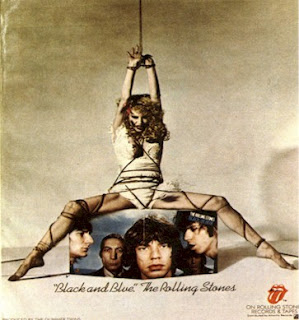
 
Found this on a blog.  Once the center fold this was
deleted with massive protests.


Unlike The Ohio Players the Stones didn’t have the rocks to put their picture of female torture and overt sado-masochism on the outside of the cover concealing it instead within the gate fold. Perhaps Mick was realizing his Clockwork Orange fantasy identity.

To add insult to injury the Stones compelled their label to erect a gigantic Billboard of the centerfold across from the Hyatt House on Sunset Boulevard in LA. The outrage was instantaneous. The outrage was so intense that Mick and the Stones were compelled to back down. The billboard was taken down while the photo was removed from the inner cover replaced by a photo of the band.

One can only imagine the effect the incident had on Rupert and his fellow merchant bankers back in London. The repercussions at all levels were horrendous.

In fact Mick owes me for that one. At that time I was in the record business in Portland, Oregon, running a large six thousand square foot store. I had a huge presence on TV and radio through advertisements thus making me an ideal target for protests. Oddly devotees of porn like Lesbians decided to target my store. A committee in combat boots stormed into my store handing me an ultimatum to not only remove Black And Blue from my racks but a long list of record covers they thought demeaned women. Interestingly The Ohio Players several covers or any records by Negro groups for that matter were not on the list. No White person was going to criticize any Negro for anything. They had immunity. The Stones however where White, objectionable and fair game. As was I.
 
Keith In Quest Of The Holy Grail

The Lesbos put their heads together to come up with a media event that they could exploit for maximum publicity. Andy always said that any publicity was good publicity but I beg to disagree with him. They conceived the notion that if they came into my store and slashed the covers of their two hundred objections that would make the paper, TV and radio. They were complicit with my employees. As the store was open till ten they chose a late hour to do their slashing. Well done, but beyond my notice until one of the Lesbos in my employ pointed the albums out to me several days later.

Of course, as I had no idea who did it, similar incidents were always happening, I pulled the damaged covers to be sent back to the manufacturers hoping that it wouldn’t happen again. There was no reason for me to complain to the police because as a record dealer I was outside the protection of the law, the police would have laughed at me. As the evil deed had received no response the Lesbos published their manifesto in their paper. Naturally enough I didn’t read lesbian publications so no response from me.

The gay crowd had their agents in the police department and the Daily Oregonian, the local rag. Unfortunately for the Lesbos as I didn’t advertise in the Oregonian it was forbidden to either mention myself or my store hence that venue was closed. Oddly enough the Lesbos used to police to try to stir me.

Now, I was in the record business. It was universally believed that every record store was dealing drugs. There were TV shows depicting it. Therefore it was believed that I was one of the biggest drug masterminds in the world. I was actually followed by police agents in London on vacation. As it happened I was there when they made a major marijuana bust so I was given attention as it was apparently thought I was there to supervise the operation. It was an interesting time. I hope I don’t have to tell you what a fantastically absurd suspicion this was. I mean, you know, it was believed that all you had to do was ask for a certain record and the clerk would slap a lid of grass on the counter for you. I mean, with a counter full of weed nothing would have been easier than a bust. But logic….

The cops had been irritants for some time so when I got a phone call saying that they wanted to help me, I say, What kind of setup is this? The sergeant or whatever begins insultingly saying that ordinarily the police didn’t care what my kind of people did to each other but this slashing of record covers was one toke over the line. Wow. It was exceptionable wasn’t it? What other things hadn’t they investigated that’s what I wanted to know but got no answer.

Quite honestly I’d dismissed the incident, didn’t remember it and thanks, but no thanks. The Lesbos were back to square one, no media event. Time passed as they revolved the situation in their drug addled minds.

Now, not only was the newspaper riddled with gays, as was my store by the way, but so was the no. 1 TV station in town on which I was a very heavy advertiser, both its radio and TV outlets. Homos and Lesbos ran the place. Time has now flown as Time will and we’re into 1977. More objectionable covers have appeared especially Ronnie Montrose’s first with the abstract painting that resembled perhaps a woman’s crotch but given the homosexual dominance of the industry by 1978 it could have been a man’s rear; the record was called Jump On It if I remember correctly. All the sexual double entendres used for decades, remember the tune Baby, Let Me Bang Your Box? Piano was meant, box being musical slang for piano as well as…(blush) you know. The Naughty Lady Of Shady Lane, for instance who was only three years old. You just have a dirty mind, that’s all.
 
Montrose- Jump On It

I was known for touting the artistic merits of the covers so getting together with their sisters at K… it was determined to do a short news feature in which I was to be induced to speak out and then they would go for the Montrose cover and get me for porno. I had no objection to their filming in my store but not having been born yesterday I wasn’t going to be drawn into the trap. I refused to speak on camera so that blew the second attempt for a media event. On to take three.

What else? The Lesbos would stage a demonstration outside the store, placards and all. However they once again made some gross miscalculations. They did get the top DJ in town also at K… and also a homosexual to announce that the demonstration would take place at noon at my store. I heard it on the radio on my way to work and was grossly offended. But, you know, too bad wasn’t it?

It was true that because of my massive radio and TV presence through advertising, and I mean massive, I was the ideal target. However many if not most people considered the demonstration as a publicity stunt which I failed to grasp at the time so didn’t turn it to my advantage and ignored it. As it would have been free advertising none of the radio and TV stations would cover the demonstration and the Oregonian certainly ignored it.

Frustrated that no media attended their media event the Lesbos decided to invade my store. A screaming horde of combat booted demons rushed in climbing on record racks, waving their signs, and with them came all the thieves and shop lifters within range of the excitement. Oddly enough many shoppers considering the ruckus a stunt went calmly about their shopping.

It took the helpful police an hour to get there and two hours to restore order. Obviously no arrests were made by the ‘helpful’ police. As Dylan sang: The cops don’t need you and, man, they expect the same. I have no idea how much money the Lesbos cost me, but they owe along with Mick. Once they realized there would be no media event their interest subsided. By that time half of 1977 was shot.

The next time Mick says that songs don’t incite a revolution smile knowingly.

Whatever was happening to me passed unnoticed as I was out on the edge of nowhere. Except for this account of the story the incident has been unrecorded. I hope the Lesbos feel rewarded. But for Rupert his world was changed dramatically on February 27th of that same year, 1977. Keith was busted for intent to distribute heroin in Toronto. The bust was as close to absolute disaster as the Stones ever came. It must also have sent a shiver down Rupert’s spine as he realized how fragile a business the Stones were.

Rupert passes over this stuff casually with a little light hearted banter but the seriousness of this ‘media event’ causes him to issue a nearly audible sigh of resignation. Rupert had spent months lining up bids from every major label for when the recording contract with Atlantic expired.

Mick gave Rupert a call to tell him the disastrous news. You can almost feel the heartbreak as Rupert resigns himself to call each and every label to ask if the bust affected their offers. It did. All signed off but…Atlantic. Ertegun stayed in but Rupert’s bargaining power went into the vein, so to speak. The Stones were only worth what Ertegun would offer. Millions down the tube. Rupert doesn’t tell us what percentage he was working on but we can assume that Keith’s bust cost him plenty.

You don’t read the story that way in Keith’s auto; he may not even still have figured it out.

That was a very serious consequence for Rupert to which I am sure Keith has given no thought ever to the possible collateral damages caused by his actions. In his drugged out haze Keith was not even aware that Rupert could no longer justify his involvement with a bunch of yobbos like the Stones. In the first place anyone associated with Rock was socially unacceptable. I as a record store owner was persona non grata in my social arena. If Rupert had held on to his social status to this point I’m sure he found that certain invitations were no longer forthcoming. Indeed, his fellows at Leopold Joseph made him choose between them and the Stones. Rupert was forced to sell out.

One feels a sort of sinking feeling in his writing as he acknowledges that Keith had sabotaged the chances of both him and the Stones. One can only hope he came out with a couple hundred million otherwise he was woefully under compensated. Rock was a world he could never have understood.

Rupert saw the Stones as a business venture without any regard of the Stones’ relationship to the expectations of their fans. Thus when he negotiated more than substantial sums for the use of Stones’ songs in advertising that was a very good business decision but a potentially disastrous situation with the fan base who saw such financial arrangements as a complete betrayal of their anti-commercialism. Rupert was frustrated that the Stones had a hard time seeing it his way.

Andrew Loog Oldham 
Besides he didn’t know who the Stones were or, seemingly so. The Stones were always a minority appeal band. When Andrew Oldham cast them as the ultimate yobbo band he was limiting their appeal to a certain segment of society. In the contemporary world where modern communications allow mind sets to come into contact and maintain communications not only locally but globally mind sets were able to blast their presence into a million or millions through communications. Thus though a small percentage of the overall global population even a perversion such as sado-masochism could appear in millions, seemingly a large connected body. Effects such as this is what Warhol was doing and through associates such as Jagger and David Bailey acting globally.

While the Stones may have sold a couple two or three million globally of their records, while substantial economically, it was not that significant culturally. Beyond the yobbo mentality the Stones had little appeal. The Black And Blue album did not expand their audience but constricted it.

Of course Mick moved the band beyond mere rock and roll by making the Stones the Ringling Bros., Barnum and Bailey circus of rock. The show was the thing. Rupert himself usually refers to Mick as a great showman. Faint praise indeed. But, once again even though the shows generated hundreds of millions it was to an already sympathetic or curious audience. Preaching to the converted so to speak.

I think that Rupert was originally blinded by the light of the Stones publicity not realizing that he wasn’t representing a universal phenomenon but a mere yobbo fragment of the population. The money was there however. I hope he valued his services accordingly.

The last half of the book meanders with very little useful information save that Rupert negotiated with unnamed buyers to sell the Stones lock, stock and barrel much as Halston sold his name, soul and product to a major corporation.

What Rupert’s motivation was except for a huge bundle of cash isn’t clear. Perhaps in some devious way he was seeking to avenge Keith’s betrayal and cause the Stone’s the pain they caused him. In any event the idea was too novel for Keith and Mick or they were two wary so the deal didn’t go down.

Perhaps there was big money in it for Rupert so that when he lost the opportunity he lost interest in the Stones. It was shortly after the deal folded that he retired severing his relationship with the group whose fortunes he had guided quite successfully for forty years.

Rupert never satisfactorily explained why he decided to abandon his respectable merchant banking career to take up a gypsy existence with the Stones. You may be sure that if I had the choice between owning a record store or being a merchant banker I would definitely have gone into banking. Anything really. You can always buy records.


Friday, March 8, 2013

Chaps I & II: Marianne Faithfull, The Faerie Queene Of The Sixties

Chaps. I & II Marianne Faithfull, The Faerie Queene Of The Sixties

November 15, 2012

Marianne Faithfull, The Faerie Queene Of The Sixties
Chapters I and II
 by
R.E. Prindle
She’s one of those girls
Who come with the Spring
One look in her eyes
Makes you forget everything.
Younger Girl- John Sebastian

 
The sixties came walking in slowly, hands in pockets shuffling along barely recognized going down the road.  Few recognized that it was a period of god formation.  All the icons of later years came from those days.  John Lennon, Jim Morrison, Jimi Hendrix, Mick Jagger.  The comptetion for goddesses was less crowded, Janis Joplin carried too much baggage, Grace Slick had her shortcomings and the rest were wannabes- except for Marianne Faithfull.  She floated through, became entangled with his Satanic majesty, Mick Jagger, crashed and disappeared from sight to reemerge damaged but triumphant.  When she resurfaced it was in another guise bearing little resemblance to the Faerie Queene of he sixties.
 
Perhaps only in retrospect does she appear as the angel of the sixties.  Only looking back does she stand head and shoulders above the women of the decade.  In her day she aspired to be Guenivere to Mick Jagger’s Lancelot.  High expectations doomed to disappointment.  Buth then the high, even ridiculous, expectations of the sixties couldn’t hope to be more than failed and fail they did.
 
The sixties were born in the despair of the World War II, the Korean War and the Atom Bomb.  The decade was shaped by the children born from 1934-38 to 1945 most heavily represented by the years of ‘42 and ‘43.  The years had their effect on those nborn in the United States but devastated those of England who formed the backbone of the sixties in both the US and England.  Stunted by ill nutrition the English boys and girls entered childhood in a world of deprivation, millions of bomb craters, square miles of devastation, limited amounts of food that were rationed until they reached their teens.  Nutrition triumphed over genes leaving perhaps a majority stunted almost to the height of midgets.  Then in the mid-fifties they came off rations as the country rebuilt and a degree of prosperity returned.  Thus the favored members of a generation with low or no expectations burst into an energized prosperity, as the flower of the sixties grew and blown in a trice.
 
Marianne herself was born in 1946, a baby boomer, in one of those ill-starred marriages of the post-war world.  Thousands of young English girls married American servicemen and left the lad of their birth forever.  Perhaps more wisely than they knew as the hundred of thousands of English men who never returned live would have left them spinsters all their lives.  As it was Marianne’s father, Glynn Faithfull met her mother in occupied Austria returning with her to England where Marianne was born.  As might be expected of a marriage made under Third Man circumstances the marriage proved ill matched each partner going their own way.  Thus by 1953 when Marianne was seven and rationing was lifted she divided her time between her two parents.
 
One ponders the effect this had on the psychological development of the girl.  Her father was one of those strange utopianists who believed the Holy Grail of personal redemption could be found in fucking so he founded some Jim Jones type of sex retreat where all the inmates were encouraged to copulated indiscriminately and freely.
 
One doesn’t know Glynn Faithfull’s background.  There may have been a couple reasons for this faith in fucking.  A significant underground current was Aleister Crowley and his faith in sex magic.  Crowley and his disciples will figure inMarianne’s life in the sixties.  His influence would continue to grow during the forties, fifties and sixties.  Perhaps more significant was the sex therapy of the one of the centuries most eminent madmen, Sigmund Freud.  While generally unaccredited for his sexual influence, his sex theories combined with his bizarre vision of the unconscious did terrific damage to the world’s psyche, especially during the fifties and sixties when his notion dominated psychology.
As a young girl Marianne was encouraged to observe the inmates copulate.  They apparently did so in front of open windows in a series of rooms fronted by a ledge or sort of long balcony.  As a young girl her father encouraged Marianne to use this ledge to view the couples at play.  In the innocence of youth she little knew what to make of this although what effect the flickering memories  played in her development she either does not say or doesn’t know.
 
Her mother removed her from this environment placing her in a Catholic convent school until she was sixteen.  The transition from open sex practices to a chastity minded Catholic education must have provided an unusual contrast in the growing memory bank of her mind.  At least Marrianne was out of harm’s way for a few years.
 
Marrianne’s mother, Mrs. Faithfull, was an Austrian.  She had witnessed the years of the Anschluss and the Nazi administration of the war years.  Necessarily as the Soviet troops moved in she suffered the horrors of the rape of the German women by the Communist troops.  This event made the Rape of the Sabine women look like a pleasure romp.  History records that when things had settled that there were long lines of pregnant German women before the hospitals waiting their turn for an abortion of a hateful pregnancy.
 
It was in this environment that Eva met her future husband Glynn Faithfull.  It was possibly love among the ruins in which Marianne was conceived.  Born out of the ashes so to speak.  ;Marianne’s mother Eva was of the Sacher Masoc line; he who gave masochism its name and wrote the Venus In Furs that Lou Reed purloined for the title of his song.  Hard core rock and rollers have been in awe of Marianne’s ancestry as though she had a hand in masochism’s naming.  Sins of one’s distant relatives and all that.
 
When Marianne escaped or was released from the nunnery she was ill prepared to deal with life on the streets, but then aren’t we all.  So as the sixties dawned this attractive girl with no prospects began to wend her way through life.  The Catholics gave her some vocal training of some sort, perhaps Gregorian chant, so Marianne took up folk singing.  Rather than the subdued tones of A Years Go By she was more of the bellowing Joan Baez variety.  Thus when Andrew Oldham asked John Dunbar if she could sing and John answered yes he was stating a fact.
 
In John Dunbar Marianne fell into one of the hippest young crowds London had to offer.  Dunbar himself was of a Bohemian mentality and he associated with the future historian of the musical and artistic scene of the sixties, Barry Miles.  Miles has never gotten the recognition he deserves.  To begin with he co-founded the very avant garde Indica Art Gallery with Dunbar.  The Indica lasted only a couple seasons but those were two memorable seasons.
 
The two entrepreneurs were discovered by Paul McCartney who, I don’t know if active is the right word, took at least an active inte3rest in the gallery which led to John Lennon’s eureka moment with the scourge of rock and roll, Yoko Ono.
 
In the course of time this led to Dunbar’s being invited to the famous party in which Andrew Oldham is said to have gallantly remarked:  Who’s the broad with the big tits?  Or words very close to that.
It was at that point that Oldham asked the musical question: Can she sing?  To which Dunbar unwisely responded yes.  Marianne, given that she was already a folksinger, sagely pretended to be at sea so that Oldham was afforded the pleasure of coaching her along.  Whether he made it inside the Magic Circle or not he had to come up with a song for Marianne to record.  More at sea over this matter the legend has it that Andrew locked Mick and Keith of the Rolling Stones into a closet, toilet or kitchen and said he wouldn’t let them out until they wrote him a song.  Thus Marianne indirectly is responsible for the Richards-Jagger song writing team with its ill fated effect on popular culture.
With Marianne Oldham struck gold the first time out.  The song Richards-Jagger wrote was a languid ditty titles As Tears Go By sung in a lisping fainting manner by the newly nominated Faerie Queene.  Songs are pretty much ephemeral to the time but within the ephemera of the time both Marianne and As Tears Go By were a very major hit.  In her way Marianne and her song was the sunrise 1964 was waiting for.

Gracie
II
…I trusted you and did my best
To make you happy.
Is this what I get for loving you?
Spector, King, Goffin
Marianne was some kind of folksinger cum chanteuse.  She had a high virginal voice.  She came from a Catholic convent school that signified purity to the English public.  In her early interviews she appears shy, modest, and if I may say, virginal.  The very antithesis of the increasing vulgarity of the times.  They set Marianne on a pedestal.
 
In the early sixties rock and roll had not yet driven every other rorm of music off the field as it would by 1970.  From 1960 to 1964-65 folk music was the dominant musical form although not of the New York purist variety; more along the commercial lines of Harry Belafonte, the Brothers Four, the Kingston Trio and Randy Sparks’ New Christy Minstrels.  Peter Paul and Mary were at their peak not year claiming to ‘love your rock and roll music’ until 1968.  In 1966 the Christies spin off The Association was a big hit.
 
Apart from sappy team acts he Beatles sparked the rock and roll revival although their wasn’t too much difference between them and the sappy teen acts.  I never did understand what the public revered in them.  Listening to the early Stones recently reminded me why I didn’t like them the first time around either; they sound quite a bit like a bad garage band.  Jagger isn’t much better a singer than Dylan, he couldn’t have been much worse.  But fate is fate and a hit is a hit.  Can’t argue with it.
Marianne then entered the lists with a number nine hit in the UK and a number twenty-two in the US.  Her second song Blowin’ In The Wind, didn’t chart while her third, Come And Stay With Me was number four UK and twenty-six US.
 
She released four LPs in 1965 which is at an exploitative rate.  No one at the time realized that the next wave of pop acts would be extremely long lived.  No one thought that the Beatles, even though they broke up, would go on dominating popular music for fifty years.  No one would have believed that the Stone would be projected a tour fifty years on.  No one could have believed that Marianne would still have a career fifty years on.  So they were trying to gut the goose that laid the golden eggs as soon as they could.  How could anyone at the time have believed that Jagger would become a pop god and Marianne a goddess?  Icons for a generation.  Unthinkable.
 
The first two UK albums charted at twelve and fifteen while in he US Marianne Faithful charted at twelve.  Her US sales then were somewhere between seventy-five and a hundred thousand copies.  She didn’t make the charts with a new title until 1974s Broken English weakly settling on the US charts at eighty-two.
 
Prior to 1964 most British bands had little presence outside their native England.  With the arrival of the Boeing 707 in 1959 the US became readily accessible while the vista for global band was opened.  First through the breach, of course, were the Beatles, soon to be followed by Bob Dylan and The Stone and even Donovan.  Most people don’t understand how big Donovan was in the sixties; almost an equal to the Beatles and Stones.  Thus the era of global popularity was inaugurated changing the face of popular music and group economics.  Oddly enough the field was limited to English and American bands for a very long time.
 
An astute manager with his eye on the future might easily have turned Marianne into a global attraction.  However Marianne after jettisoning Andrew Loog Oldham after her first two single signed with some small minded English putzes who were both incompetents and only interested in exploiting her.  Somewhat like Edie Sedgwick in New York it was all there waiting to be picked up but no one saw it.
 
It does seem that they saw the image ready for use but ignored it.  Where was that eagle eyed Allen Klein I wonder.  Marianne herself was into Queen Quenivere, King Arthur, the Holy Grail and the faerie aspects of the epic.  The record people got it.  For instance the liner notes on the back of the US Faithfull Forever US release quote from Keats’ La Belle Dame San Merci:
 
I met a lady in the meads
Full beautiful- a fairy’s child.
Her hair was long, her foot was light
And her eyes were wild.
I made a garland for her head
And bracelets too, and fragrance zone
She looked at me as she did love
And made sweet moan.
I set her on my pacing steed
And nothing else saw all day long
For sidelong she would bend and sing
A fairy’s song.
She found me roots of relish sweet
And honey wild and manna dew
As sure in language strange she said
“I love thee true.”
 
So there it was.  Everything was in place but the management wasn’t there.
It really couldn’t be seen in 1964 that this was the year of myth making in popular culture, actually ‘64, to ‘66.  Marianne had all the elements to make her as big and long lasting as, say, Bob Dylan.  She already was a myth.
 
Perhaps Mick Jagger of the Rolling Stones surveying the horizon saw this.  Ever envious he may have said to himself ‘This woman is a threat to my supremacy;  I must destroy her.’  I can’t say but he did sidle up to her, pour some wine down between her breasts and with that introduction proceed to seduce her whispering ‘Come stay with me.’  A couple years later he threw the remains aside.
And Marianne plunged into a deep depression.


  •  


  •    


    Sunday, February 24, 2013

    Chaps. 3,4,5: Marianne Faithfull: The Faerie Queene Of The Sixties


    Chaps 3,4,5: Marianne Faithfull: The Faerie Queene Of The Sixties

    December 15, 2012

    Marianne Faithfull: The Faerie Queene Of The Sixties
     

    by


    R.E. Prindle


    Chaps. 3, 4, 5

    Marianne In Leather 


    Chapter 3
     
    Of all the performers of the Rock era Mick Jagger and Paul McCartney have been the most successful while I would give the nod of most successful to Jagger. One must admire the way he learned the ropes and then used them to strangle others as he had been strangled. Mick in his own way was the Midnight Rambler and the Street Fighting Man. Don’t think I blame him; you either rule or are ruled. But, one does have to live with the reputation one creates.
    Mick began cultivating his image from the beginning. As this story concerns Mick’s relationship to Marianne I will concentrate on aspects of their sexuality. Andrew Loog Oldham made a movie of the Stones’ January 1905 Irish tour. Unfortunately he sold the rights to it along with the Stones 1963-70 master recordings to Allen Klein along with, by the way, the first Marianne Faithfull masters. Klein then became the Stones’ manager.
     
    The movie disappeared into Klein’s archives to surface in November 2012 when the Klein estate released it to DVD. It can now be purchased, as I did. The DVD features both the Abkco edit and Oldham’s original Director’s Cut.
     
    Mainly a concert film it also features group member interviews and Richards and Jagger cutting up. While they were horsing around they appear to improvise a song with the lyric: I’d rather be with the boys than here with a stupid girl like you.
     
    While Jagger has always cultivated an ambiguous image he has also announced a record of having had sex with four thousand or more different girls. That’s only eighty per annum over fifty years so I imagine that shows an admirable restraint. Yet, at the same time Mick has always been misogynistic while always seeking to emasculate or squash his closer women under his thumb. In fact Mick probably has a domination or emasculation complex. He may have rather been with the boys but in his competition with them he sought to emasculate or squash them too. One of the favorite forms of emasculation and domination is to take other men’s women from them.
     
    Thus when he took Jerry Hall from Bryan Ferry he quipped he had to do it to save her from going through life as Jerry Ferry. One winces when one reads of Eric Clapton begging Mick not to take Carla Bruni from him. Mick even took one of Eric’s temps, Catherine James from him.
     
    Mick And Chrissie
     
    When Mick first enters the scene for Andrew Oldham he is in an alley fighting it out with Chrissie Shrimpton, the model Jean Shrimpton’s younger sister. If one reads more deeply into that situation it shows a very cruel sadistic streak in Mick, quite shameful in a celebrity of Mick’s first magnitude of brightness.
     
    Chrissie began the relationship as a strong willed girl battered by and battering Mick. In that day before the change in sexual mores girls weren’t quite so sexually open so Chrissie didn’t want her parents to know she was shacking up with Mick. They insisted to Mick that they not. As a humiliation tactic to break the girl down he let it be known to her parents that in his eyes she was little more than a common whore and she and they should see it that way too as he was in fact shacking with her.
     
    Gradually the monster beat her down, completely destroying her self-respect then, more than publicly, he broadcast his triumph on records and over the radio with such songs as Stupid Girl and Under My Thumb which their whole circle knew referred to her. Dylan would later use the same tactic against Edie Sedgwick when he wrote Like A Rolling Stone to break her down.
    Both Chrissie and her parents believed Mick and she were to marry but having crushed her beneath his thumb, as it were, with a toss of his curly locks Mick sneeringly walked away adding insult to injury. Cruel in this instance it became psychotic with repeated use.
    Years after word got back to Mick that Chrissie had a bundle of his letters, and, now this is unforgivable, without a word to her he immediately set his attorneys on her threatening an expensive law suit while demanding she return his letters. Even though Chrissie had not intended to publish them, still shaking this long after Mick’s brutal treatment, Chrissie without delay forwarded her letters from Mick to him. Shameful.
     
    Mick And Marianne
     
    Mick then turned his attentions to the Guinevere, the Ophelia, the Faerie Queene of pop music, our Marianne. While I’m sure Mick was somewhat enamored with Marianne I’m also sure he had a couple ulterior motives. Marianne was married to John Dunbar at the time while living with Mick so Mick had the pleasure of emasculating and humiliating Dunbar.
     
    At the same time I’m sure he was envious of Marianne’s fame which was probably greater than his at the time. No room in the spotlight for two. He couldn’t stand that Marianne was getting even more press than himself. Thus he undertook to destroy her career. In the process he emasculated her and humiliated her to an astounding degree.
     
    Marianne and Mick were playing with psychologies in a very destructive manner. The events I am going to describe did incalculable damage to their psyches while altering the direction of their subsequent lives dramatically, especially Marianne’s. Of course, few people seem to realize they have a psychology or how it was formed, what expectations they devised. Those hopes and dreams were more especially dashed when they turned to drugs. That was certainly the case with Marianne.
     
    I don’t know how seriously Marianne took her Medieval interest and reading but she was influenced by her Arthurian studies. Like the most or possibly rest of the generation she was also influenced quite heavily by Alice In Wonderland and Peter Pan, probably both books and movies.
     
    The key for the generation in Peter Pan was his refusal to grow up or accept adulthood. It was quite fashionable at the time to pretend that you would always be young, keep in contact with your ‘inner child.’ I was a victim of the psychosis myself.
     
    At any rate Marianne was influenced by all three. Thus, when she and Mick met she quizzed him extensively on his knowledge of King Arthur to see how much he knew as though that litmus test would seal his fate. Mick passed and Marianne moved in still married to John Dunbar. Thus her life clashed with her Catholic upbringing. At first Marianne had royalties coming in from her records enabling her to maintain a certain independence but gradually the royalty checks decreased making Marianne financially dependent on Mick.
     
    At the same time Mick was under no obligations to Marianne and observed none. How this clashed with Marianne’s Arthurian expectations in an atmosphere of Peter Pan and Alice she doesn’t go into but there must have been a severe disappointment as Mick treated her as a mere possession.
     
    While in California he was the object of desire for all the groupies including the doyenne Miss Pamela- Pamela Des Barres nee Miller- of Frank Zappa’s girl group the GTOs (Girls Totally Ornery or else in reference to the hottest car of the period, the GTO). Miss Pamela as well as the rest of the California groupies studied to come up with better and better more outrageous sexual thrills with which to astonish the boys in the band which easily surpassed the imaginations of the boys in the band including Mick's.
     
    Mick returned home and demanded of Marianne that she perform these tricks which astonished Marianne no less than Mick had been astonished. However she believed the tricks degrading. Marianne quite rightly refused to perform them.
     
    But the repertoire of the boys in the band kept expanding so that the home girls were led to view new horizons. Group sex and that sort of thing became the norm.
     
    As with all loosely knit movements or phenomena this sort of reputation brought more and more of the sado-masochistic libertine drug oriented element, gradually forcing out the less inclined to sexual erotica just as bad money drives out good money. Rock and Roll became progressively more degenerate from 1964-65 on until it was disgraceful to be associated with it.
    Mick and the Stones were leaders of this degeneration whether the Stones embraced sexual sado-masochism personally their public persona was based on it making them leading corruptors of youth and society in general. They did as much or more to change the sexual mores of the present as anyone. Their LP cover for Black and Blue was the apex of this very sado-masochistic misogynistic persona. The cover caused me all kinds of trouble in running my record store.
     
    As one presents oneself so must one be.
     
    Chapter 4
     
    The Redlands Bust.
     
    Many psychologically devastating events happened to Marianne in the years from 1967-70. It is very difficult from this perspective to evaluate some of them. One can’t tell how Marianne’s renunciation of her career affected her mind. After all in 1964-65 and 66 she went from  being just another teenager to superb success far beyond her expectations financially, while becoming the female idol of  England and a phenom in the US- ultimately the Faerie Queen of rock and roll. That’s really only two short years until the Redlands bust.
     
    In those two years she passed through several sexual transmogrifications. She went from virgin to the most outre of sexual practices. It's all very well to say that this was her decision but as Paul McCartney said of his own experience in Miles’ biography it was impossible for him to resist peer pressure, especially in the use of drugs. He was ‘forced’ to try heroin even though he was dead set against.
     
    So peer pressure on Marianne and any young girl to be sexual ‘free spirits’ was impossible to resist unless you were prepared to accept group rejection. The same with drugs that couldn’t be resisted so that when depression set in she ended up addicted to the greatest depression drug available- heroin. It was up to Mick to give what protection he could. Regardless of current sexual nonsense it us up to the man to guide his woman.
     
    Now, the era began in relatively clean-cut innocence . It was never quite so white bread as it is depicted, trying to escape the sleaziness, even then, was no easy matter. Then as the decade wore on it all got worse, then it got disgusting. First pot, pills and amphetamines, then LSD that came on like a hurricane. LSD more than anything else conditioned you for cocaine that came in at the end of the decade, at least on the West Coast where I was.  Remember that there was no national consensus in the US.

     In 1964 or so when the ‘counter-culture’ hit in the Bay Area it was a very local manifestation not shared by the East Coast the Mid-West or even for that matter LA. LA was never hip in the way the Bay Area was. While the Beatles are credited with introducing long hair, when the Charlatans came down from Virginia City they had hair and they must have been growing it long before the Mop Tops showed up.
     
    The West Coast could not tolerate New York groups. Mafia outfits like the Rascals nee Young Rascals and Vanilla Fudge made the West Coast puke. There really wasn’t any place for The Velvet Underground either. Of course the British groups that had their own sound that really couldn’t compete with that of say, The Doors, an LA group. The LA groups being more commercially oriented pretty much shoved the Bay Area groups aside, although there were a couple of real successes. I don’t include freak groups like the Grateful Dead, commercial successes. Cults are cults.
     
    But to the point, boy, LSD. Owsley Stanley kept the West supplied and how. By the time of Altamont and Stonewall the atmosphere was really foul. And then it got worse still.
     
    About the time of the Redlands bust society and the police were losing their patience. Kesey and Leary had them terrified. The drug thing kept growing. When one says that marijuana was generational it is true only to the extent that a significant minority of the generation smoked it. The hippies were only a small and despised part of the generation but they, we, made a lot of noise and got a lot of notice. Without the radio, rock and corrupt record companies the Movement probably wouldn’t have broken the bounds of Bohemia. But, the time was ripe for the Bohemian conquest of America. That was led from New York, principally by Andy Warhol.
     
    The records made the Bohemian life seem very glamorous. Thus the cops focused on groups, where actually the greatest drug activity was located and the propaganda the strongest. As the groups began to make good and even big, very big, money they were the natural prey of the drug dealers. And don’t underestimate the role of LSD. The groups also chose to flaunt their drug use- ‘I’ve got to be free to put anything into my body and life I want to’, disdaining the law, the police and actually common decency. This was the case with the Stones and it’s the flaunting, not the use, that got them in trouble.
     
    In 1967 they naturally were set up. Brian Jones in an interview, barroom chat actually, with News Of The World reporters boasted of his drug use. The journalists then attributed the statements to Mick, whether from ignorance or design I leave to your imagination.
     
    When Mick read the article he was indignant. As I said, while Mick and the rockers thought they were big because of records, radio and TV they were actually socially marginal and not particularly appreciated. Musicians get no respect outside their own circle.
     
    Rather than evaluate his situation, considered that he was doing drugs and everyone knew it thus making him an obvious target, he foolishly brought suit against the newspaper. You don’t have to be brilliant to know News Of The World wasn’t going to let that one fly. Hey! Hey! What’d I say! Mick was sleeping or dreaming.
     
    The police wanted to get England’s bad boys anyway. There may or may not have been collusion between the News Of The World and the police but the way the raid was conducted indicates there was.
     
    Shortly before the bust some guy named Schneiderman drops from the sky with a brief case reportedly filled with whatever you required. Mick, Marianne and Keith and a couple others, I will mention in the next section, were having an LSD weekend at Keith’s house, the Redlands. Schneiderman insinuated himself into the party with his briefcase while probably being in the employ of the News informed them and they in turn notified the police.
     
    For Schneiderman allegedly having a briefcase full of drugs there were remarkably few drugs in evidence at the bust. Jagger was booked only for possession of four pep pills bought legally in Italy, while Keith had no drug charges at all except for being charged with ‘knowingly’ providing a place where pot was smoked. Robert Fraser actually had heroin jacks of his own on him but Schneiderman produced nothing from his briefcase and indeed no drugs were visible in it when the police required him to open it. No drugs were seen only packaging that were assumed to contain drugs by the Bohemians. In any event he hopped the first flight to elsewhere.
     
    While Marianne had no drugs concealed on her person her situation was the most tragic of all. The Faerie Queen would lose her official status.
     
    When the cops came calling the crowd was of course flipped out on LSD but then that was always the danger; the cops would come calling when you’re least prepared to deal with them. Come on, this was just one of the hazards of using illegal substances. And naturally, you tend to be flippant, wise cracking and mocking. Very bad behavior in such a situation when maximum seriousness is the order of the moment. It’s not like everyone didn’t live in fear of being busted. They used to call it deep paranoia.
     
    Marianne whose clothes had become wet from walking in the rain laid them out to dry dressing in nothing more than some sort of rug wrapped around her. Well, what is one to think of a nude woman amongst a bunch of men; what is this Dejeuner Sur L’herbe redux? Even if two thirds of them were screaming fairies as they were, how is one to know that and what to think?
    It was said that Marianne let her wrap slip giving the coppers an eyeful. Of course the cops were square and the gang was hip but squares outnumber hips by a very large margin while as Roger Miller sings: Squares make the world go round. And a good thing too. Roger said that hips have too much water for their land; this was a gathering of pretty watery people. Oh, OK, my people, but folks you have to be realistic. That’s what hip means in my book.
     
    And then someone probably at News Of The World concocted the story that Marianne had a Mars bar slipped between her legs and that Mick was grazing away at it. Preposterous, wouldn’t you think? Boy, now that was a blow that will getcha and you’ll be down for a long time too. As might be expected Marianne was devastated. Boy, that opened a lot of anfractuosities in her brain. A hit like two trains running in opposite directions at top speed on the same tracks over a two hundred foot high trestle. That’s a big crash and a long way to tumble, buddy.
     
    It ended any hope Marianne may have had of appearing on a stage. Can you imagine stepping up to the microphone and being showered with Mars bars. Oh no, no,no, better to board a rocket ship for…oops…Mars.
     
    Marianne and Mick may have thought they were handling it well but the bile and psycho-somatic reactions entering the sub-conscious aren’t so easily dismissed. This horror was merely added to their childhood fixations.
     
    In the turmoil of the months succeeding this mind wrenching event fixations would only worsen. Of course the intent of the establishment was not so much to succeed in jailing them but making an example of them while hopefully destroying their careers. The bust should have been career destroying but for the generational gap. When a teacher chastises a student the other students smirk but don’t disown him. After busting Mick and Keith the establishment then went after the more fragile Brian Jones, the guy who got this whole thing rolling by shooting off his mouth. If the three could have been jailed they wouldn’t subsequently have been allowed to enter the US or so it seemed. No one could have forecast the incredible changes that were about to occur that essentially placed the Stones above the law.
     
    Chapter 5
     
    Enter Donald Cammell And His Movie Performance
     
    One reads many amusing reasons for the incredible social disintegration of the sixties. One of the most preposterous to come to my attention is the notion that it was caused by lead poisoning.. There’s a hobby horse for you. While I couldn’t rule it out I think lead poisoning would be among the most obscure of reasons. No, the sixties was no more an aberration than was Hitler’s Germany; like the latter it was the result of long historical development, a part of psychological history.
     
    If one reads a good deal with the purpose of understanding the historical background of the sixties things begin to take form. Then if one tries to make one’s intellect rise and float over the information gleaned from that reading patterns will form, a map of the past will appear. Then of course one notes nodes and axons, connections that require further reading and rereading what’s already been read so that a fair approximation of what happened can be more or less confidently stated. Much of it will be subterranean history that doesn’t make it to the history books.
     
    Such is the psycho-sexual mind set that began to develop oh, say, about from 1890 on which a key node from 1900 to 1920. Western understanding of the human mind developed fairly rapidly from the mid-eighteenth century rapidly gaining momentum after say 1860 and the spectacular doing at Paris’ Salpetriere mental hospital under the tutelage of the amazing Dr. Jean-Martin Charcot.
     
    While his investigations were of a psycho-sexual nature they were not perceived as such except perhaps by a transient student by the name of Sigmund Freud. Sometime after Charcot’s studies toward the nineties people calling themselves sexologists, sex therapists and sex magicians began to appear.
     
    Along with Freud who might be called a sex therapist two leading figures slightly earlier than he were the German Richard von Krafft-Ebing (1840-1902) and the Englishman Havelock Ellis (1859-1939). In the academic scientific or pseudo-scientific manner all three made their contributions although Freud managed to incorporate their discoveries or understandings into his system acquiring preeminence in the field.
     
    Goerg Groddeck and Wilhelm Reich, two of Freud’s disciples also gained prominence in the sex therapist field.
     
    On the religious or supernatural side the most prominent and influential of the sex magicians was the so-called Magus Aleister Crowley and his organization of the Golden Dawn.
     
    With the exception of Krafft-Ebing all were out to overturn European sexual mores, designated disparagingly as Victorian. Of course there was never a time when men and women didn’t behave sexually because…well, how could they? The real goal then was to disturb prevailing sexual mores and replace them with sexual license. This essentially came to fruition in the 1960s when the influence of Freud and Crowley were at their peak. The two principal cultural nodes of the US, New York and Los Angeles, were flooded with European Jewish émigrés of the Freudian school while Aleister Crowley had established himself and his Golden Dawn in Los Angeles.
     
    The corrosive sexual mores of Freud and Crowley were aided and abetted by the rise of the equally corrosive drug use and, of course, ‘lead poisoning.’
     
    Our next object then is to discover who Donald Cammel might be.
     
    Searching For Donald

    Donald Cammell 
     
    Cammell is the central figure in this little drama so we will begin with him although even though the Stones biographers don’t delve into these other characters they are integral to the social scene of Mick, Marianne and Keith. It appears that Brian Jones, Bill Wyman and Charlie Watts served a peripherals to Mick primarily and Mick and Keith secondarily. Oldham tried to make himself a third but apparently was incompatible or other interests pulled him in a different direction. By ‘67 he would be out of the picture.
     
    In Marianne’s biography she makes it sound like Cammell was a stranger to the group while actually he was well known to Bob Fraser, and Chrissie Gibbs who were at the Redlands bust and quite familiar with Mick, Keith and Marianne. They all knew each other before the movie began to be filmed.
     
    Cammell was older than the other three being contemporary with the first generation of rockers; he was born in 1934 in Scotland. He came from a well to do family immersed in the occult; his father actually knew Aleister Crowley and wrote a biography of him. One may then assume that his father was something of a sex magician as Marianne’s father was a sexologist. It was impossible to escape Freudian influences from at least 1920 through the fifties. So some reference to repression and the unconscious is inevitable.
     
    Cammell’s father was likely familiar with Krafft-Ebing’s Psychopathia Sexualis with its emphasis on psychotic sexual practices. All the sexologists and magicians immersed themselves in bizarre sexual practices. If a reader counters that all sex is legitimate it shows how perverted he or she is. No argument from me, we know where each other stands.
     
    As Cammell was born in ‘34, in ‘44 he would have been 10 and 20 in 1954. Thus he would have been aware of the war between the ages of 4, 5, 6, or so and 10 but perhaps in a muddled and uncomprehending manner but in ‘44 and ‘45 he would have been aware enough to partially comprehend. Certainly when the Big Baby turned Hiroshima to ashes in August of ‘45 something would have registered affecting his mind and outlook.
     
    I was 7 in ‘45 and while I have a clear remembrance of VE Day I don’t have any recollection at all of the Bomb or if I do it had little or no significance to me. I have never had a horror of the A-bomb.
     
    Obviously something other than lead poisoning affected the psyches of the crop of kids from ‘33-’34 to 1942-43. It may have had something to do with the total destruction of the world capped by the Bomb. What a terrific exclamation mark to the end of hostilities. What Cammell’s reaction to this destruction was isn’t clear to me while it probably wasn’t clear to himself.
     
    After the war he experienced rationing during the whole of his teen years. He was probably less affected than others as he became prosperous in his teens on his own as a painter. He was successful as a portrait painter. From the pictures I’ve seen he was more than talented while possibly possessing genius. His mind already exhibited an extreme darkness with sexual confusion easily perceived.
     
    Much of the following information comes from web sites such as the fabulous Another Nickel In The Machine that records the history of London, Sam Umland’s 60X50 and many others. I have not read Umland’s biography of Cammell as yet.
     
    Cammell divorced his first wife and then married a very successful model, the American Deborah Dixon, moving to Paris where they both lived. Cammell apparently was supported by his wife.
     
    Bored with painting, not unlike Andy Warhol, he began to take an interest in film. There is nothing like a movie to exhibit one’s sexual fantasies in real life; indeed a movie is a record of the unconscious. Cammell and Dixon were sexually compatible taking an interest in anything remotely copulatory. Cammell’s first few attempts at filmmaking were not successful or, at least, lacked box office magic.
     
    Along with his lack of interest in painting and his attraction to the movies Cammell gravitated toward the pop world of rock and roll seeking out Jagger. Where was a sexual degenerate to turn? The bad boys of Rock, the Rolling Stones, Mick, Keith and Marianne at least. He found Mick and Marianne’s talked about sexual escapades irresistible. He was undoubtedly attracted by Mick’s dope legend also. Mick claims not to have been an excessive user of drugs, which may be true, but I doubt there was anyone at the time who didn’t think he was a heroin addict and druggie par excellence.
     
    As an artist Cammell was acquainted with Bob Fraser and that pop art crowd. Both he and Fraser were known to the infamous crime lords, the Kray Brothers. The Krays, of course, were homosexuals as was Fraser and Gibbs. Mick’s legend is that he is bi-sexual, at least, so there is no reason that he wasn’t sexually involved with the bunch in some manner.
     
    Cammell and Fraser also knew the Satanist and sex magician, the American experimental film maker, Kenneth Anger, as did Mick and Marianne. Fraser introduced Anger to the underground film crowd.
     
    In addition Anita Pallenberg knew Cammell from her pre-Brian Jones, Keith Richard days. She was shown the script in the south of France the year before filming began. So, unless I have seriously misread Marianne’s first auto-biography, Cammell didn’t just show up one day with a movie proposal; it was actually old home week.
     
    Cammell did go on to make an additional three or four movies of which I have seen two, Demon Seed and Wild Side. The last movie has escaped my vigilance so far. Wild Side is a virtual remake or variation of Performance. Demon Seed that I will review in an addendum to Chapter 5 is actually a great movie handling a major sci-fi theme to perfection.
     
    Just prior to the beginning of filming in 1968 Mick impregnated Marianne. This is 1968 and if Marianne hadn’t been on the Pill she would have had a number of children now in addition to Nicholas her child by John Dunbar. The question then is why she allowed herself to get pregnant at this time.  She was still married to Dunbar so one must think he must have suffered humiliation and emasculation to have another man impregnate his wife. Perhaps Mick’s emasculation genes or maybe just a drug haze.
     
    At any rate Marianne was exiled to Ireland while filming was going on. One can only imagine the anxiety she felt separated from her lover in her condition. One doesn’t have to imagine; she suffered a miscarriage.
     
    Point Blank

    John Boorman 

     The Movie
     
    In 1967 the English director John Boorman had filmed a movie that took
    Cammell’s mind by storm. The movie was Point Blank starring Lee Marvin as the protagonist Walker. Cammell recommended that all the cast see the movie and bear it in mind. It might be advantageous to review the movie here.
     
    Point Blank was only Boorman’s second effort. Unsuccessful on release it has apparently become a cult classic. His movie is obviously a dream sequence or nightmare. Nothing is real. This is indicated by the hero’s name of Walker. He has only one name, no first. No one even knows what his first name could be. The name seemed significant to me but I hadn’t a clue as to what it could mean. Well, you know, when the student is ready the teacher will appear. While writing this piece I was also reading Denis Machail’s 1941 biography of J.M. Barrie, the author of Peter Pan. There on page 190 was the explanation of Walker. Barrie had written a play titled Walker, London. That was a telegraphic address.
     
    Two impudent jokes in one the second even more mysterious then as it is now. For the word ‘Walker’ is still in the dictionary- “interjection (slang) expressing incredulity and suspicion of being hoaxed” but when was it last used? Not during the present century, one would say; yet before that there was a time when it was the very crystalization of Cockney humor. “Walker!” you said, to show that you could never be caught with chaff. It was the standard answer to the attempted leg pull. It was also one of those blessed with that which any comedian could bring down the house.
    So now the viewer knows he is being hoaxed and suspends belief. The plot involves Lee Marvin as Walker who takes part in a heist then is shot by partner who runs off with Walker’s share or 93,000 and adding insult to injury Walker’s wife. The rest of the story involves Walker trying to retrieve his money, forget the wife. The story is told through a series of frustrations to a paranoid Walker. So, we have a dream study of a frustrated paranoid hoax.
     
    The opening and closing settings are the same. The walking or exercise area inside Alcatraz prison. The joke seemingly being that one walks around and around, never getting anywhere while returning to the same place. Cry “Walker” and then start laughing like a Cockney at the joke.
     
    Alcatraz, the Rock, is of course a small island in the middle of San Francisco Bay between the Golden Gate and the Bay Bridge. Established in 1934 it was closed in 1963, so the filming was done in a closed facility and before the Indians occupied the island claiming it as their heritage. The filming was done, then, in vacated premises.
     
    As a dream story it concerns the psychic life of Walker. It’s all going on inside his head. The prison, castle or house represents the psychic  self so that Walker lives a bleak, barren, paranoid inner life.
     
    A helicopter lands in the enclosure, picks up a package and leaves a bundle of money. Walker and his pal Mal (mal, French for bad) kill the messenger while robbing him. Walker is then examining an empty cell signifying his empty life when Mal with Walker’s wife looking on puts a couple bullets in him leaving him for dead while appropriating Walker’s share of the money and his wife. Thus we have some basic paranoia that, of course, might possibly be true. As his wife would say later, Walker just kind of left her cold.
     
    Left for dead Walker somehow recovers while being compelled to take the only way off the island available to him- swim for it. Another grim joke as legend has it that no one who tried ever succeeded.
     
    The rest of the story concerns surmounting treachery and double crosses Walker encounters in trying to recover his money. He finds his wife, abandons her and takes up with her sister. While he seems a little obsessive-compulsive in the matter, the money in fact represents his lost identity, purpose in life or masculinity. The recovery of the money is central to his personality.
    As in the Cockney joke whenever he shows up people exclaim “Walker!” If you’re in on the joke it might be funny. Angie Dickenson makes up the sex interest as Chris as there is no love interest. Just a four letter word in this movie. The three kingpins Walker must knock down are Carter, Brewster and Fairfax. Ironically Carter and Brewster are disposed of by their own team when Walker’s paranoia protects him while the others take the hit meant for him.
    The actual climax takes place in Brewster’s house when Walker and Chris have spent the night together, the only consummated sex in the movie. As Walker is walking out the door Chris asks does Walker know what her last name is. Walker doesn’t know and neither do we. Walker counters, seemingly weakly, does she know his first name. Either check mate or an uproarious joke to Cockneys. But as Walker in joke is a hoax or a put on then it doesn’t matter anyway. Dreams are like that, they follow a different logic than the waking mind.
     
    The denouement returns to the opening at Alcatraz but now Walker is more canny staying out of sight. The drop is made, Brewster calls to him to come get the money. But, as when Walker was supposed to get the money from Carter, after he survived the assassination attempt, the bundle proved to be waste paper, Walker’s paranoia saves him again. A shot rings out and Brewster takes a long walk off a short pier never to return again. Now enter Fairfax who is the head man and the assassin who shot Carter and Brewster and would have shot Walker. Fairfax shouts Walker several times that in another century would have brought the house down.
    Walker’s paranoia prevents him from taking what might be money in the bundle but is probably waste paper so that as the bundle of funny paper represents his ego he is left stranded in the haunted empty house of Alcatraz representing his mind for one presumes the rest of his life.
     
    The movie was a box office failure, except for the happy few like Cammell but holds up well as a psychological thriller. That is what Cammell saw. So, now, he’s basing his own movie ‘Performance’ directly on Point Blank.
     
    Performance
     
    He gathers together essentially the ‘gang’ to make his movie. Even Deborah Dixon took part. He already knew and was friends with James Fox as was apparently Mick, cast as the criminal Chas. Cammell had known Anita Pallenberg in Paris where it is said she formed a brief menage a trois with Cammel and Deborah. Chrissie Gibbs was the set designer…Mick was an old friend, a few outsiders and he had his movie.
     
    Mick sent Marianne to Ireland for the duration. Keith who was shacking with Anita was so unhappy about Cammell’s pairing Anita with Mick that he found it impossible to visit the set. Instead he brooded outside in his car sending Bob Fraser in to keep tabs until Cammell banned him from the set.
     
    I can’t be sure that Cammell understood the Cockney meaning of Walker but he so admired the character that he based Mick’s role on Walker giving Mick the single name of Turner. No first. Turner is also meant to be significant. A turner is a sort of acrobat. The word could also be used in the sense of changeling, or perhaps in the homosexual sense or turning a man gay. Turner does turn Chas. from a tough guy to a passive fairy, his sort of changeling. Turner changes the tough hoods into faggots. Probably then that is the meaning of the name. So maybe Cammell was in on the Walker joke.
     
    As the movie is permeated by sex magic and sex as a sort of therapy the influence of Krafft-Ebing, Ellis, Freud and especially Aleister Crowley is very apparent. Kenneth Anger was around at the time while being known to all the participants thus reinforcing the Crowley connection.
     
    All the sex therapists were concerned with aberrant sexual practices that the movie concentrates on. Cammell elaborates the sexual implications of Boorman’s Point Blank, while the decaying mansion obviously represent Cammell’s mind. In the end the sex therapy or magick doesn’t seem to work as Turner turns suicidal obsessed with a death wish.
     
    Boorman’s crime angle comes in through Chas. In order for Fox to appear authentic Cammell actually required him to live the criminal life under the tutelage of a mobster, even to the extent of taking part in actual crimes. Of course, madness is a theme of the movie but even madness can go too far.
     
    Chas. has offended the criminal chief, based on the Kray Bros., who has commanded a man to track Chas. down. When he is located he is summoned to his execution. Turner says: Don’t leave me, take me where you’re going. Chas. says ‘You don’t want to go where I’m going. Turner: Yes I do. Chas. then blows Turner’s head off, gets into the car and the car drives off as he looks out the window we see Turners face. Thus the turning or change is complete as each becomes the other.
     
    The version now available for purchase or rental is apparently much different from the original. While even the available version is violent and pornographic the original must have anticipated the current pornographic output of Hollywood . While I wouldn’t call Performance tame almost every movie you see today is as or more explicit. At any rate the movie has no redeeming moral value. If you want porn plain and simple, there it is.
     
    The legend has it that the movie changed the lives of the participants. Perhaps so, but perhaps not. Michele Breton was already a lost child and stayed lost. Anita, no stranger to drugs moved into intense familiarity. James Fox, who was criminally mistreated by Cammell, gave up movies for ten years but he says he was already fed up with the seedy side of movie making so perhaps Performance just capped it. Keith, god, what can you say? Who was going to keep him from drugs? If Cammell was already inclined toward suicide he topped himself off in 1996 finally taking Keith’s advice.
     
    But, now, Mick and Marianne. Mick was advised to play himself but Marianne wisely overruled that advice perhaps saving Mick’s sanity but still leaving him off balance. Marianne advised him to adopt some of the fey characteristics of Brian Jones' character along with some of Keith’s tough stance. Not too difficult as that is the way Mick already appeared but it permanently shifted his personality in that skew. Nevertheless Mick has always remained supremely functional.
     
    As to Marianne, how did she relate to Mick’s rejection of her by sending her to Ireland and the subsequent miscarriage of her child. That is a lot of psychological battering. I think that it is certain that as 1968 progressed she was already in a depression and sinking rapidly. While she was able to hold on for another year or so, by 1969 she would be spinning out of control as further events tested the strength of her mind.
     
    Chapter 6 follows.


    •  

    •